Eight-Year Roman Bath Excavation in Spain Unveils Ancient Splendor
The Romans, once again, demonstrate their mastery of engineering and building at a recently new Roman Baths discovery near Elche, Spain.
After eight seasons of detailed excavation, archaeologists from the University of Alicante have completed one of the most significant Roman bath complexes ever discovered in Spain. Located at La Alcudia near Elche, the Eastern Baths span roughly 14,000 square feet and showcase the wealth and sophistication of the Roman colony of Iulia Ilici Augusta during the 2nd century AD. This site offers critical insights into Roman urban planning, social life, and the role of public baths as centers of community and leisure in Hispania.
The complex includes all the traditional elements of Roman bathing culture, such as cold rooms (frigidaria) and hot rooms (caldaria), but its most striking feature is a massive swimming pool, or natatio, demonstrating advanced Roman hydraulic engineering. The scale and design of this facility indicate the prominence of Ilici within the broader network of Roman cities. Additionally, the baths contain two exceptional mosaics: one imitating marble paneling and the other decorated with intricate floral motifs, highlighting the aesthetic sophistication and artistic ambitions of Roman Hispania.
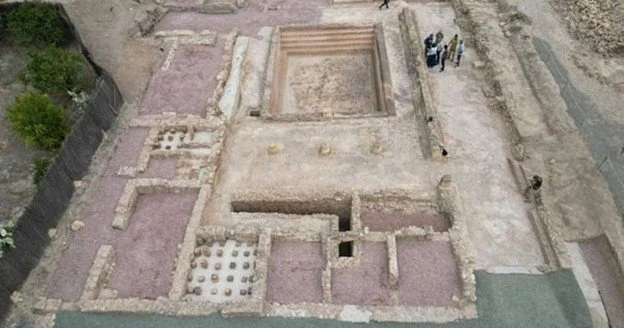
Excavation Site Near Elche, Spain
Evidence suggests the baths gradually declined during the 3rd and 4th centuries AD, likely due to broader economic and demographic challenges facing the Roman Empire. Partial restorations were attempted, but by the 5th or 6th century, the complex was abandoned. Beyond the baths, excavations revealed a 55-meter stretch of Roman street with paved surfaces, drainage systems, and building entrances, allowing researchers to reconstruct part of the city’s infrastructure. Remarkably, an even older Iberian neighborhood dating back to the 3rd century BC was also uncovered beneath the Roman layers, demonstrating the long history of urban development at the site.
The Eastern Baths are now being preserved with advanced conservation techniques, enabling public access and future museum development. Professor Molina emphasizes that the site will serve as both a research hub and a cultural resource, providing an enduring testament to the engineering, artistic, and social achievements of the Romans in the Iberian Peninsula. As such, La Alcudia not only enriches our understanding of Roman civilization but also illustrates the complex layers of history embedded in Spain’s urban landscapes.