Deeply Traditional The Flamenco
When travelers envision Spain—particularly the southern region of Andalusia—the enduring image of the flamenco dancer often comes to mind: a woman in a vividly colored dress and a male counterpart executing intricate, percussive footwork. Beyond this romanticized portrayal lies a historically grounded art form shaped by the cultural interplay of southern Spain. Flamenco developed within the folkloric traditions of Andalusia and was profoundly influenced by the Gitano (Romani) communities of the region. While closely associated with Gitano heritage, flamenco is distinctly Andalusian in character and has historically been practiced by artists of both Gitano and non-Gitano ancestry.
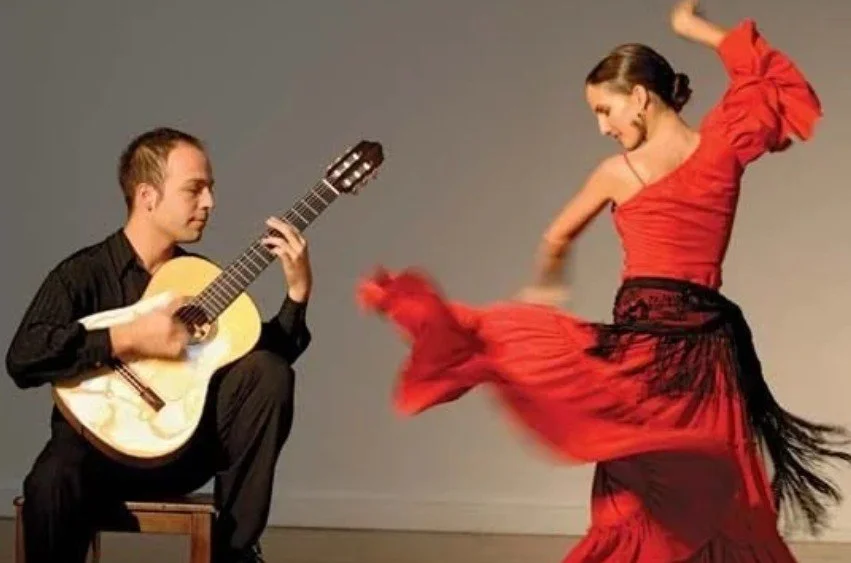
Recognized by UNESCO as an Intangible Cultural Heritage of Humanity, flamenco integrates three principal elements: cante (song), baile (dance), and toque (instrumental performance). Cante conveys an expressive range encompassing grief, longing, joy, and celebration, typically accompanied by guitar. Baile reflects both technical discipline and emotional depth, with stylistic distinctions often observed between male and female performers. Toque, once limited to accompaniment, has evolved into a virtuosic tradition in its own right, complemented by palmas (rhythmic hand-clapping) and castanets—known locally as palillos. Scholars generally trace flamenco’s documented emergence to the late eighteenth century in Lower Andalusia, with Jerez de la Frontera frequently cited in early references, though extant records from this formative period remain sparse.
Within Seville, the neighborhood of Triana has long been regarded as a vital center of flamenco culture, sustaining generations of performers and daily exhibitions of the art. Among the city’s established tablaos, Los Gallos Tablao Flamenco, situated in the historic Santa Cruz quarter, offers an intimate performance environment that preserves the immediacy characteristic of traditional flamenco. The venue presents a balanced repertoire of solemn and exuberant styles, highlighting intricate guitar technique, compelling vocalists, and dancers whose heritage often reflects longstanding ties to Romani traditions.
The setting at Los Gallos accommodates a modest audience, allowing close observation of the guitarist’s rapid fingerwork, the sharp articulation of palillos, and the nuanced expressions of dancers and singers as they interpret each composition. Although rooted in centuries-old tradition, flamenco remains a living art, renewed with each performance through improvisation and individual expression. The cumulative effect is both emotionally resonant and culturally instructive, offering insight into a tradition sustained through communal memory, familial transmission, and enduring regional identity.