Miguel de Cervantes, one of Spain’s greatest writers, gave the world an unforgettable character in Don Quijote. Taking the name Don Quijote de la Mancha, the aging gentleman sets out across the Spanish countryside in search of adventure, accompanied by his loyal squire, Sancho Panza. Convinced that the age of chivalry still lives, Don Quijote tries to right wrongs, defend the helpless, and restore justice—even when the world around him bears little resemblance to the heroic romances he has read.
Cervantes brilliantly combines comedy with tragedy. We laugh as Don Quijote mistakes ordinary inns for castles, flocks of sheep for armies, and windmills for fearsome giants, yet beneath the humor lies something deeply touching. Here is a man whose imagination transforms an ordinary world into one filled with honor, courage, and possibility. Beside him stands the practical Sancho Panza, whose common sense provides the perfect contrast to his master's lofty ideals. Together, they create one of literature's greatest partnerships, constantly reminding us of the tension between the world as it is and the world as we dream it might be.
The importance of Don Quijote reaches far beyond Spain. Published in two parts, in 1605 and 1615, the work is widely regarded as one of the foundations of the modern novel and has influenced writers throughout the world for more than four centuries. Cervantes experimented with narrators, fictional documents, stories within stories, and even characters who become aware of the existence of the book in which their adventures are being told. These techniques were remarkably innovative and helped transform the possibilities of literary storytelling.
Don Quijote is therefore much more than the story of a misguided knight wandering across La Mancha. It is a timeless exploration of imagination, dignity, friendship, disappointment, and the human desire to make life more meaningful. I highly recommend reading the novel—or listening to a well-performed audiobook, where the contrasting personalities of Don Quijote and Sancho Panza truly come alive and make the adventure even more enjoyable.
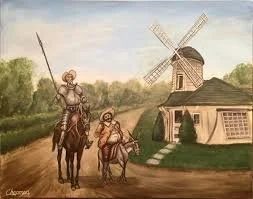
Don Quijote and Sancho Panza
As we follow the pair through the landscapes of Spain, Cervantes continually shifts between laughter and sadness. Don Quijote's famous charge against the windmills is wonderfully absurd, but it also reveals something admirable about him: no matter how often reality defeats him, he refuses to abandon his ideals. Sancho may question his master's judgment, but he remains devoted to him, and their friendship gradually becomes the emotional heart of the novel. Through them, Cervantes shows us that loyalty, hope, and companionship can survive even the most ridiculous—and difficult—circumstances.
The novel's influence on literary history is difficult to overstate. Often described as the first modern novel, Don Quijote changed how authors could develop characters, play with different levels of reality, and even question the reliability of the storyteller. Writers from many countries and centuries have drawn inspiration from Cervantes, and the names Don Quijote and Sancho Panza have become recognized far beyond the Spanish-speaking world. More than four hundred years after its publication, readers still recognize themselves in its conflict between idealism and reality.
For anyone exploring Spain's cultural heritage, Don Quijote is essential reading. Cervantes created far more than a comic adventure; he produced a profound meditation on friendship, courage, imagination, aging, failure, and the determination to keep pursuing one's dreams. Whether you experience it on the printed page or through an expressive audiobook performance, traveling alongside Don Quijote and Sancho Panza remains one of the great journeys in world literature.